Case Study · Home Services
Red Hawk Roofing
A 640-page storm-intelligence platform for a Colorado roofing contractor — replacing a vendor-controlled WordPress site with software the client actually owns.
- 640 Pages in production
- 139 Cities with real storm history
- 695 NOAA hail days mapped
- 751 Data claims verified at build
The brief
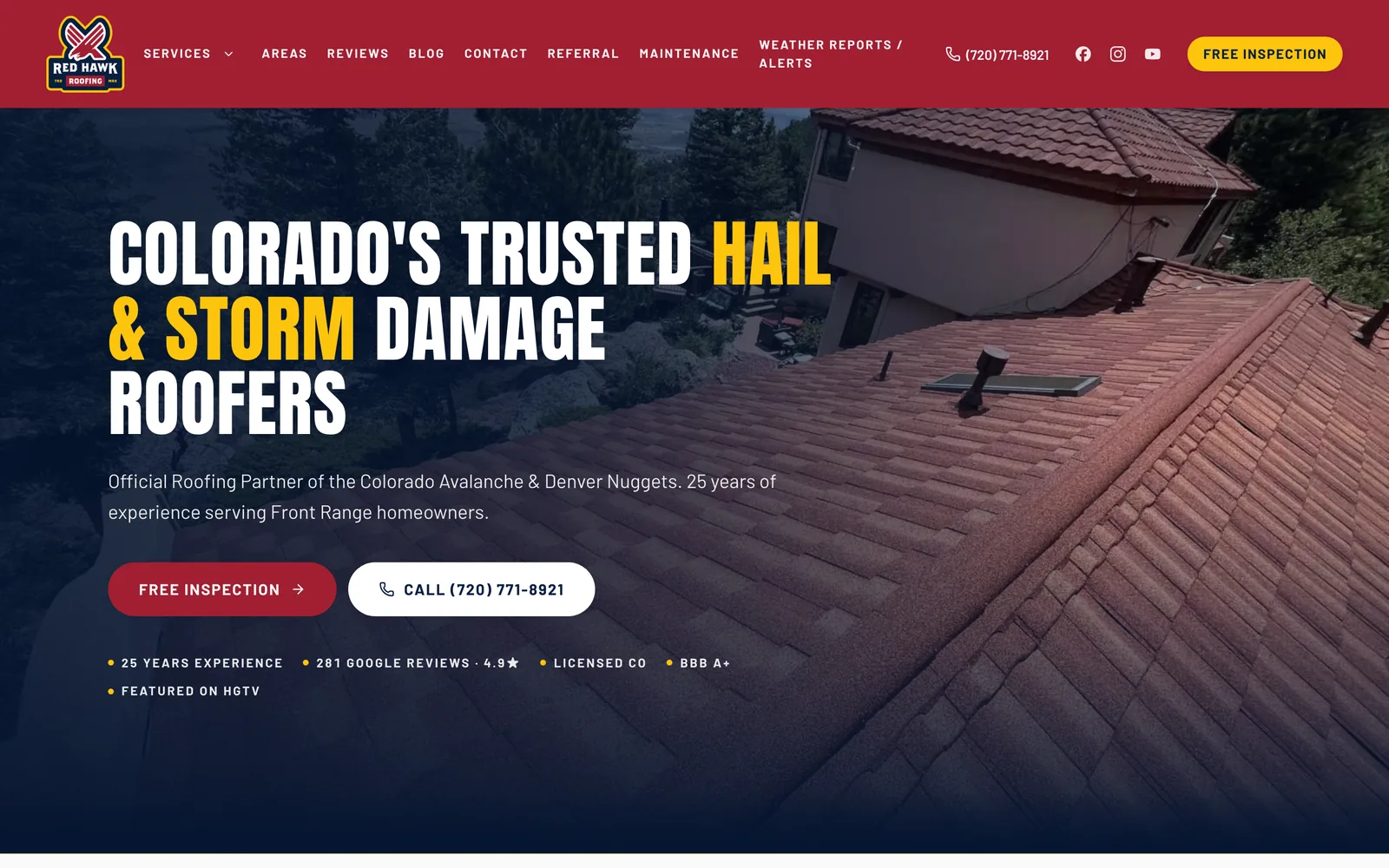
Red Hawk Roofing is a Front Range roofing contractor — official roofing partner of the Colorado Avalanche and Denver Nuggets, and featured on HGTV. Their web presence did not match that.
The old site was WordPress, hosted on a marketing vendor’s account, with three separate outside firms holding admin credentials. The company could not deploy a change without asking someone else. Email had never been properly authenticated. Local coverage was thin in a market where storm damage is intensely geographic — a hailstorm hits one suburb and misses the next.
The company also had something most contractors do not: access to a federal storm-data pipeline through a sister firm, ExoVzn. Nobody had ever turned that into something a homeowner could use.
Three goals: own the infrastructure outright, cover the Front Range city by city with real content, and turn NOAA storm data into a customer-facing product.
What we built
-
A city-by-city local surface
139 Colorado cities and 442 service × city pages, each with genuinely local content — county, ZIPs, school district, permit authority, and that city’s own verified hail history. Not spun templates.
-
Property-level storm intelligence
Homeowners drop a pin on their own roof on a satellite map and get a two-year hail report for that address, generated as a PDF, free.
-
Insurance & cost tooling
A roof cost estimator calibrated against real market pricing, a roof-age calculator, and step-by-step claim guides anchored to Colorado statute.
-
A lead pipeline that does not drop leads
Bot protection, rate limiting, first-touch attribution, and a dead-letter queue with retry — so a third-party outage degrades the form instead of silently losing the customer.
Local pages that look local
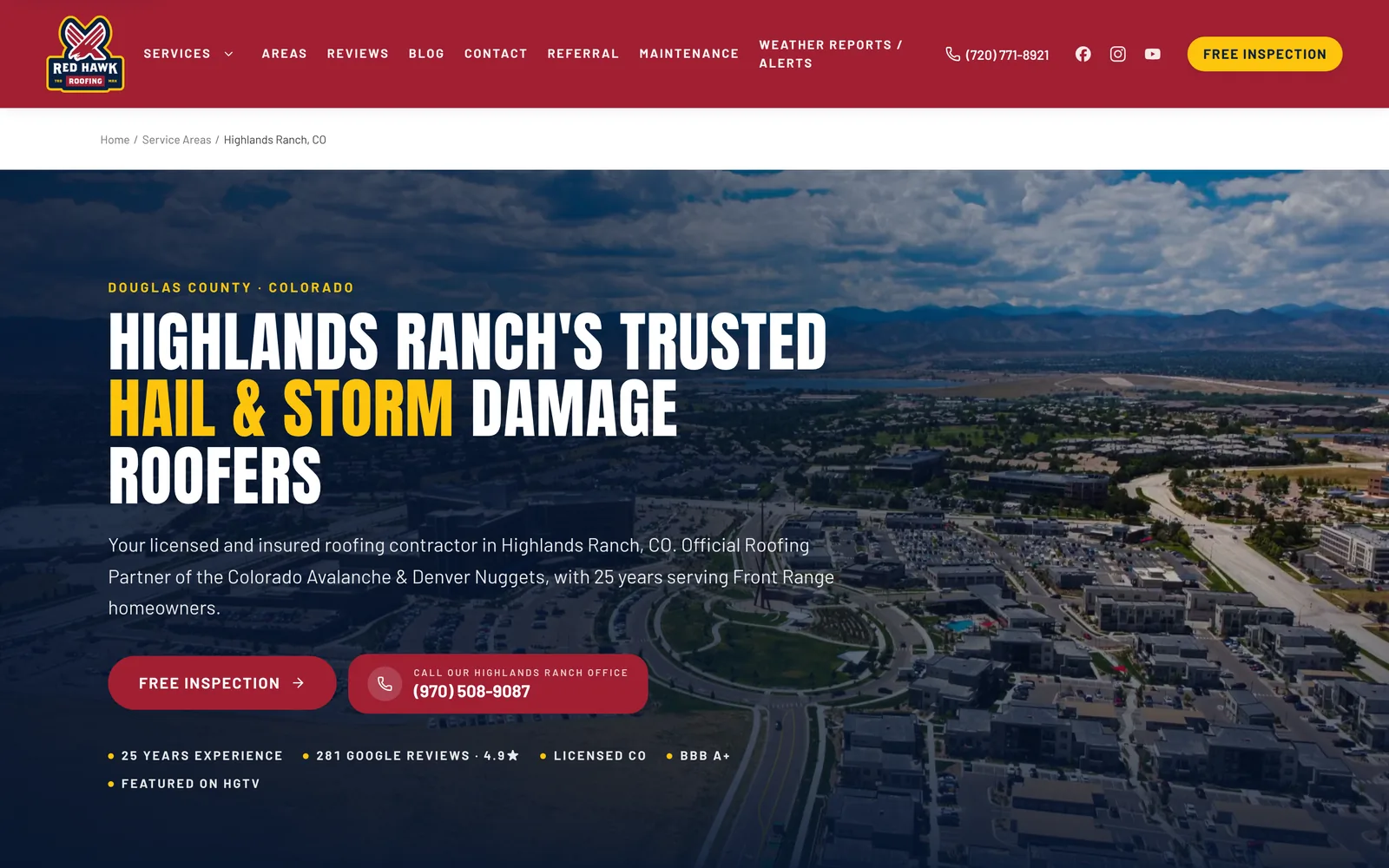
Programmatic city pages usually announce themselves — same stock photo, same paragraph, swapped city name. These do not. Over a hundred of the 139 cities carry a curated, coordinate-verified, properly licensed photograph of that actual place, sourced and checked one at a time; cities with no good free photograph fall back to branded roof imagery rather than shipping something bland and wrong.
Each page also routes to the nearest of five offices, so the phone number a visitor sees is the one that serves them.
Federal storm data, made useful
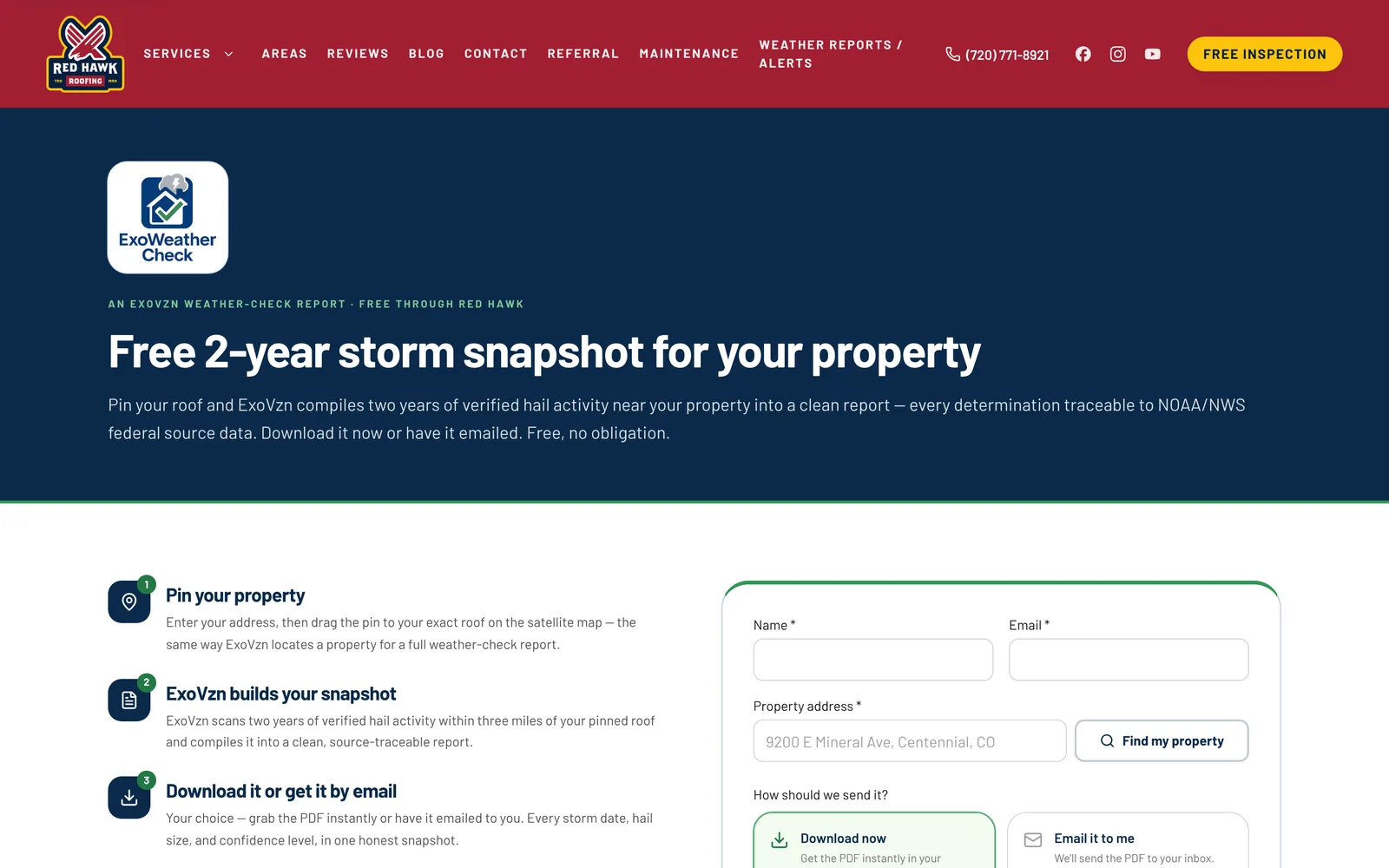
The storm tools integrate ExoVzn’s forensic-weather API to compile verified hail activity near a pinned property into a clean, source-traceable PDF — generated on demand, delivered by download or email.
The honesty of this is the point. Radar-estimated hail and ground-confirmed hail are reported as different things, because they are. Of the 695 hail days mapped across the service area, 672 are ground-confirmed, and the site says which is which.
Tools that answer the real question
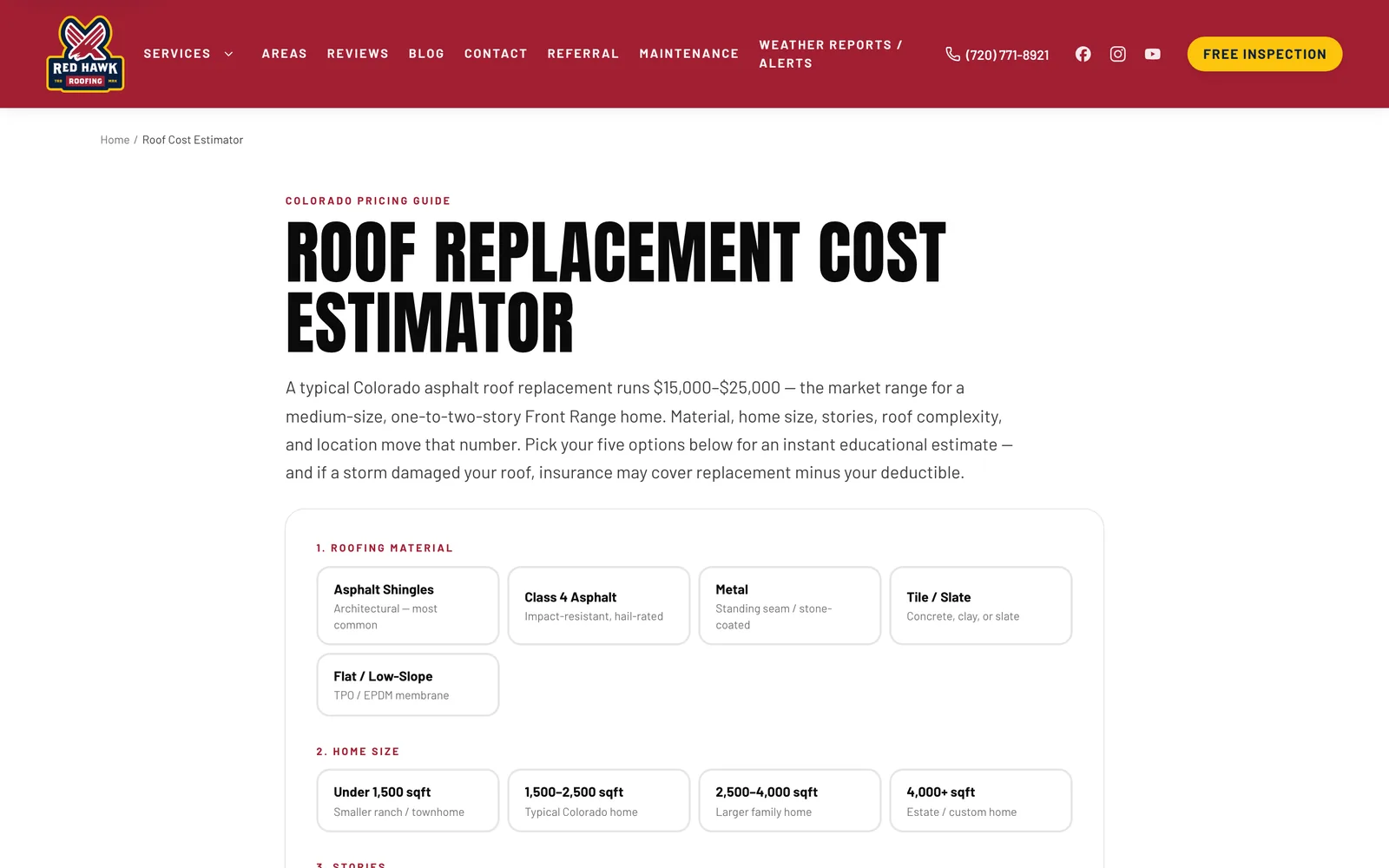
Most roofing sites hide price behind a form. This one leads with a range and an interactive estimator, then explains the five factors that move it — and pivots to the insurance conversation, which is what actually determines what a Colorado homeowner pays after a storm.
Engineering notes
Two decisions are worth calling out, because they are the ones that keep paying off.
False claims fail the build
A roofing site makes hundreds of factual assertions — hail sizes, dates, city counts, review totals. On most sites these drift until someone notices. Here they are gates: a checker validates every numeric hail claim on every page against the source NOAA dataset (751 claims at last run), a link gate walks all internal links, and a counts gate keeps page and city totals derived rather than hand-typed. If a claim stops being true, the deploy fails.
Review counts pull from the Google Places API at build time across all five business profiles, so the number on the site is the number on Google — without anyone updating it.
Built for AI answers, not just search results
The site ships structured data throughout plus an agent-readable layer — llms.txt, a full content export, and an agent.json manifest declaring capabilities, sourcing rules and crawl policy. When an AI assistant is asked about roofing in a Front Range city, the site is legible to it as data rather than as a page to be scraped and guessed at.
The stack

Migration without losing the equity
Cutting over a domain that has been indexed for years is where these projects usually leak value. Every legacy URL was mapped and redirected, and all inbound backlinks were verified to land on a live page after the switch. Email was moved onto properly authenticated infrastructure — the domain published DKIM for the first time in its history during the cutover.
Google discovered all 633 submitted URLs on launch day and had indexed 503 of them within five days.
Where it stands
The site has been live since July 2026 and is under active maintenance — storm data refreshes, new city coverage, and continued conversion work. App0110 Labs remains the engineering team behind it.
Red Hawk owns the repository, the infrastructure accounts, and the domain. That was the point.
: ExoVzn →
Want something like this?
Tell us what you are trying to build. We will tell you honestly whether we are the right team for it.
Start a project