Case Study · Data Platform
ExoVzn
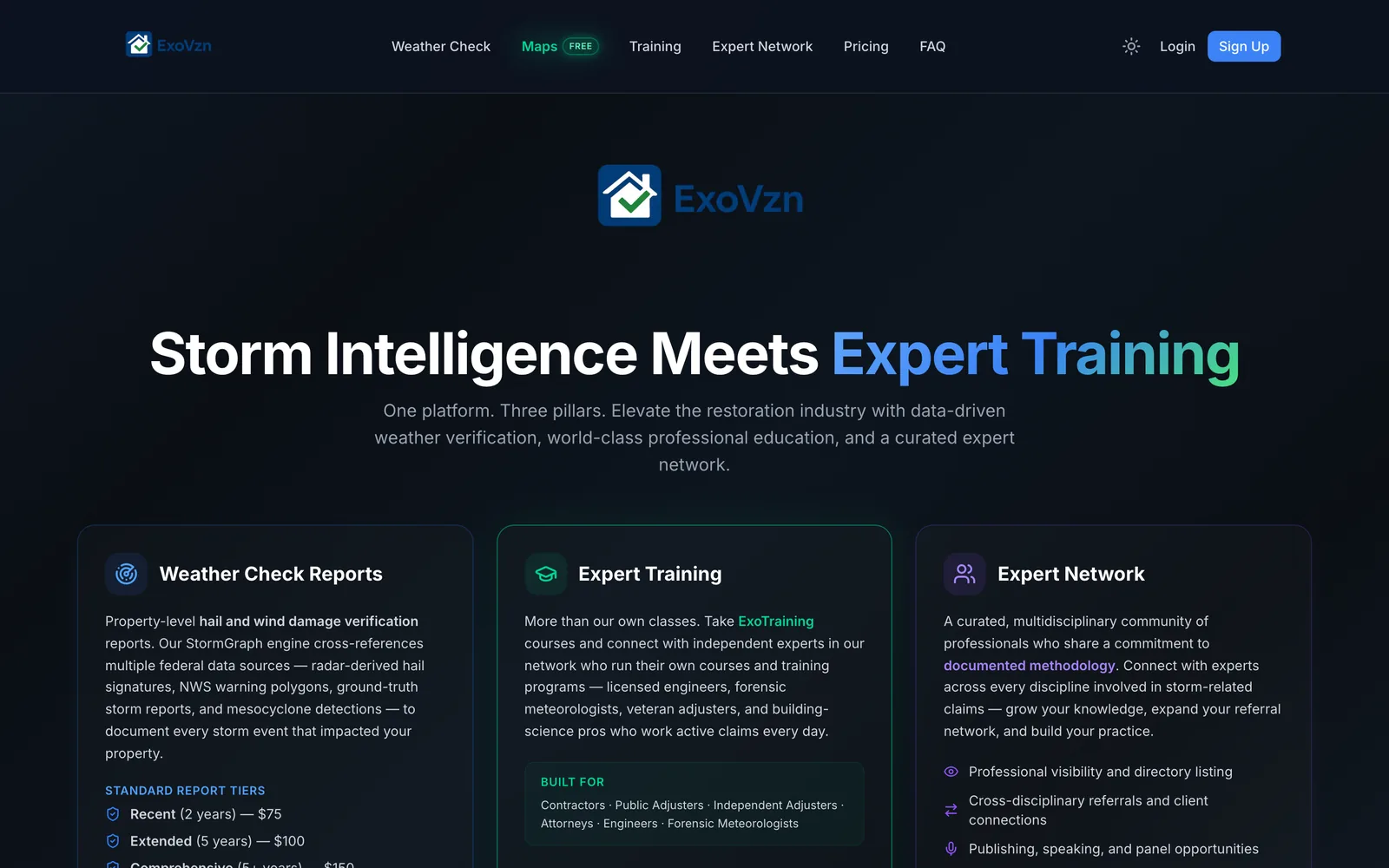
A storm-intelligence platform: 600 million weather records, a multi-source correlation engine, and an automated report factory — built from a peer-reviewed forensic methodology that previously existed only on paper.
- 600M+ Storm records indexed
- 12 Independent data sources
- 229 Auto-refreshing data pages
- 3 Peer-reviewed papers implemented
The brief
ExoVzn's co-owner is a licensed Professional Engineer and Diplomate Forensic Engineer who had spent five years publishing a weather-verification methodology in the Journal of the National Academy of Forensic Engineers. The method was sound, peer-reviewed, and — as software — did not exist.
Verifying whether hail actually struck a specific roof on a specific date is genuinely hard. The authoritative data is scattered across federal databases, radar-derived products, warning archives, and volunteer observer networks. Each source disagrees with the others in predictable ways. Doing it properly meant a trained expert spending hours per property, which does not scale to an industry that needs thousands of these.
The brief: turn a published methodology into a system that produces the same rigor automatically, at a price a contractor or public adjuster would actually pay, without ever overstating what the data supports.
What we built
-
A multi-source correlation engine
StormGraph geocodes an address, defines a search radius, and cross-references twelve registered data sources across three tiers — official records, radar-derived products, and community observer networks — scoring each candidate event on proximity, coverage, cross-source agreement, and source reliability.
-
An automated report factory
Orders run through a queue-backed pipeline that produces a full PDF, an interactive web view, and a CSV export within 24 hours — work that previously took an expert hours per property.
-
A daily national map pipeline
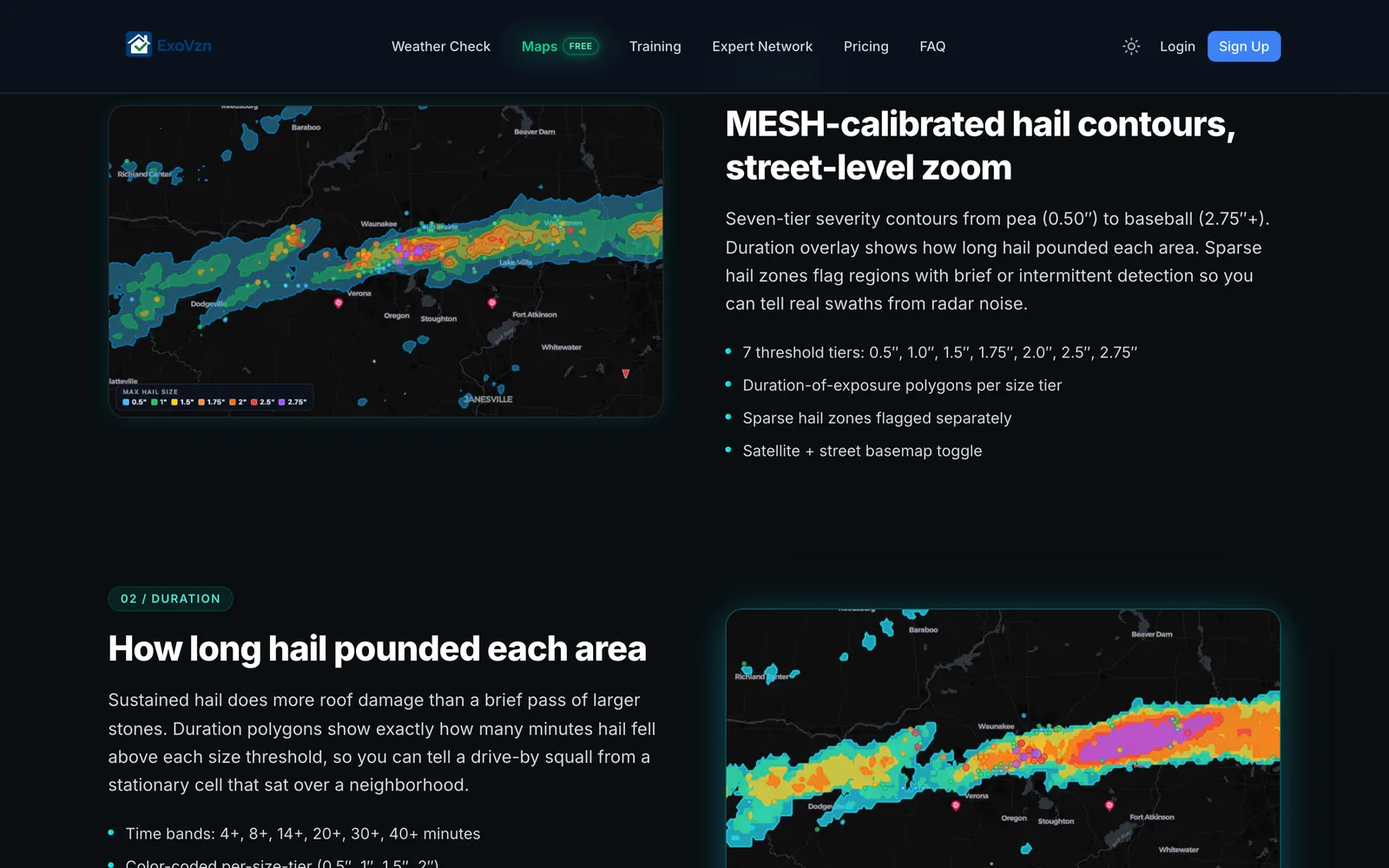
Scheduled jobs ingest radar data every day and publish national hail and wind maps with MESH-calibrated severity contours, duration overlays, and warning polygons — free, with no paywall.
-
A partner API with billing
Approved partners order reports programmatically against a documented OpenAPI surface, with a sandbox environment, metered and prepaid billing, and per-tenant isolation.
Radar data people can actually read
The maps render seven severity tiers from pea to baseball, plus a duration overlay showing how long hail fell above each threshold — because sustained hail does more roof damage than a brief pass of larger stones, and no consumer product was showing that.
Sparse-detection zones are flagged separately so a user can tell a real swath from radar noise. That distinction is the difference between a defensible claim and a guess.
A content surface generated from the database
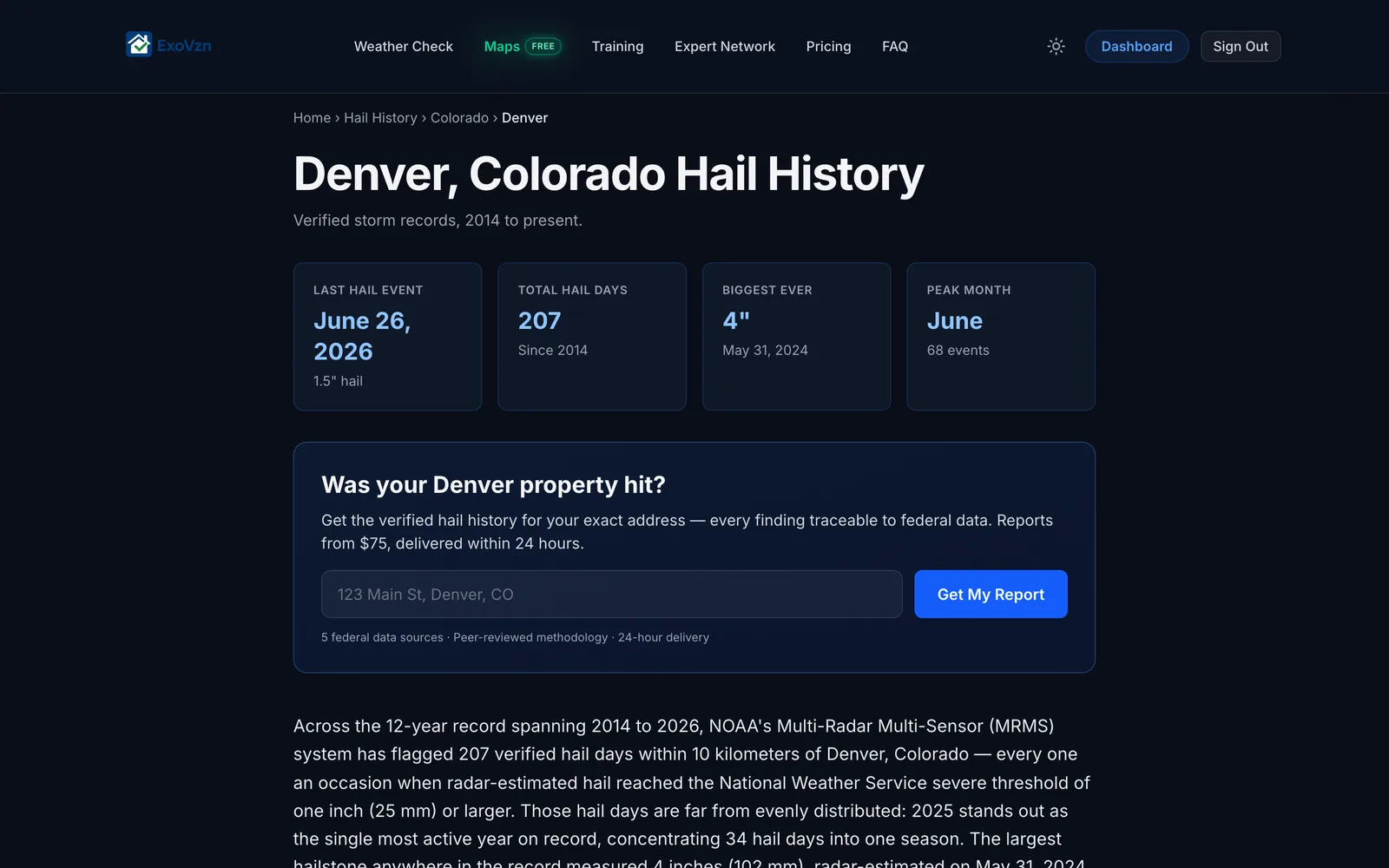
229 location pages — 198 cities and 31 state overviews — are rendered directly from the record base and refresh on a schedule. Every figure on them is queried, not written: hail-day counts, largest recorded stone, peak months, per-source freshness.
Nothing is generated prose. If the data changes, the page changes; if the data does not support a number, the page does not print one.
Honesty as an architectural constraint
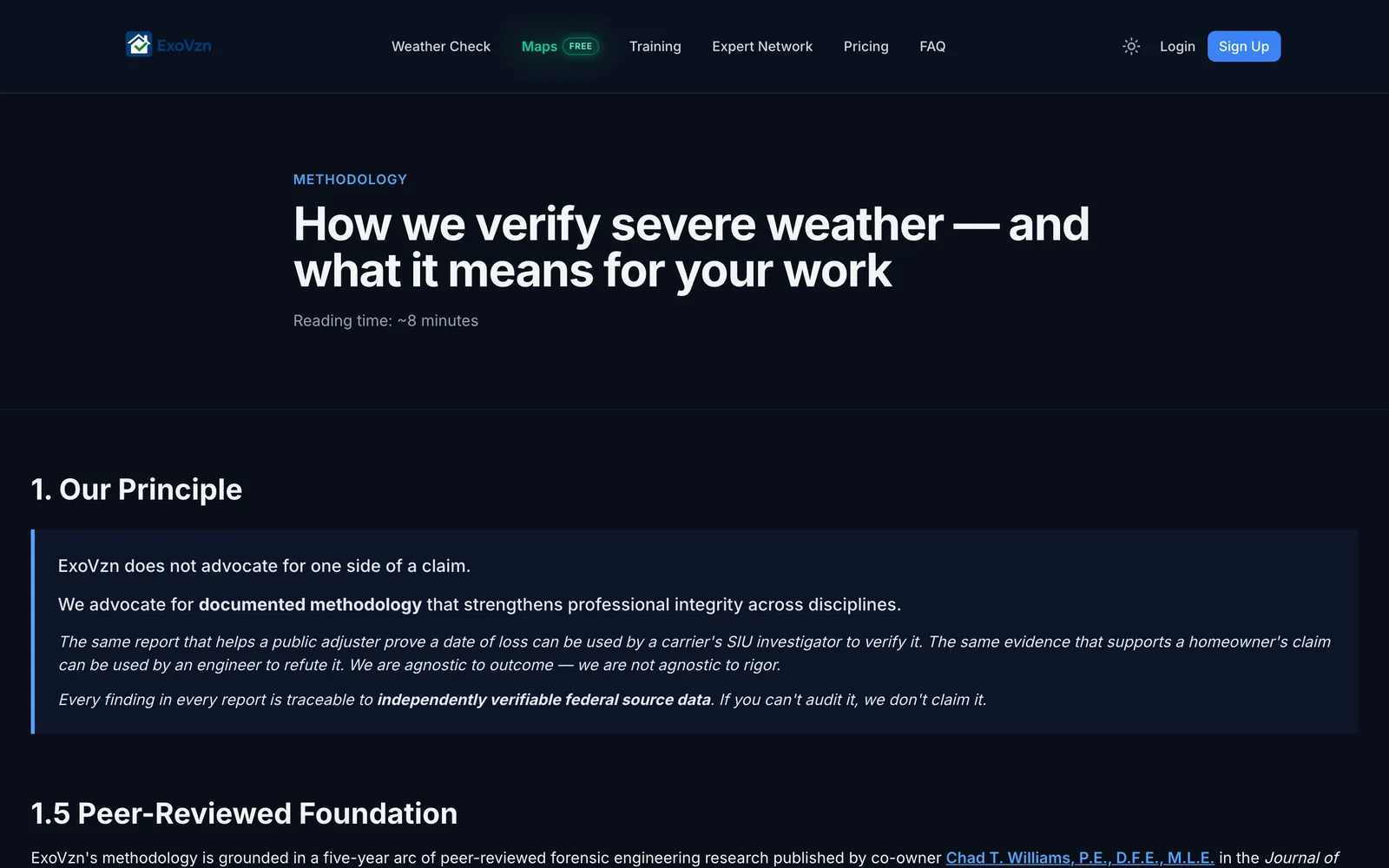
The hardest engineering requirement on this project was not throughput — it was restraint. Radar-estimated hail and ground-confirmed hail are fundamentally different classes of evidence, and the system is built so they can never be conflated.
Every accepted event carries a confidence tier and its sourcing. Events that were considered and rejected are listed too, so a reader can see what the engine looked at and chose not to claim. The published principle is that if a finding cannot be independently audited, it does not get asserted.
Engineering notes
Not one application
ExoVzn runs as several cooperating services rather than a monolith, because the workloads are genuinely different: a user-facing web application, a Python API for the meteorological analysis, an asynchronous worker for report generation, and scheduled data-pipeline jobs. Report generation is queue-backed so a slow or failed job degrades one order rather than the site.
The methodology is the spec
Most projects derive requirements from stakeholder interviews. Here the requirements were three published papers, and the correctness bar was whether a credentialed forensic engineer would sign their name to the output. That changes how you build: confidence scoring, source precedence, and the handling of timezone boundaries across storm dates are all implementations of documented method, not product decisions we were free to make.
Built for AI answers, not just search
The platform ships structured data throughout — including Dataset markup that makes its storm data citable and ScholarlyArticle markup tying findings to the underlying papers — alongside an agent-readable layer of llms.txt, a full content export, and an agent.json capability manifest. Deploys announce changed URLs via IndexNow rather than waiting to be recrawled.
The stack
Where it stands
ExoVzn is live and in active development. The map pipeline runs daily, the location pages refresh themselves, and the platform now carries three product lines — verification reports, professional training, and an expert network — on shared infrastructure.
App0110 Labs designed the platform, builds it, and runs it end to end.
Have a hard data problem?
This one started as three academic papers and a spreadsheet. Tell us what you are working with.
Start a project